Adoption notices for scobey’s caches have started going out today July 30. If you signed up to adopt one of scobey’s caches, the e-mail account you linked to your geocaching.com account will receive and e-mail from “Geocaching” with the title ”You have a geocaching adoption request.”
To complete the adoption process, open the e-mail and click this link:
The following window will pop up in your default browser:
Click the three “yes” boxes and “accept.” A second window will open which reads:
Click the “view your new listing” to view the cache page that now appears under your profile. You may edit and update the cache page as necessary using the “Admin Tools” in the upper right hand corner of the page.
If you missed out on adopting a scobey cache and would like to, the list is posted in the GeocacheAlaska! forums at https://geocachealaska.proboards.com/post/22975/thread. Reply to the post with the GC of the cache(s) you wish to adopt and you will receive an adoption notice will be sent to you within a week.
Accessibility meets adventure: the Birkenstock-friendly guide to geocaching
BirkenstockReport is an Alaskan geocacher with a mission: to make geocaching more inclusive and accessible while celebrating adventure and exploration in all its forms.
As a young adult, an autoimmune disease left BirkenstockReport paralyzed for 6 months. Now in recovery, she wears Birkenstocks, a type of sandal, to help her feel the terrain underfoot.
With each geocache she finds, she leaves a “Birkenstock-friendly” rating to let others know what kind of terrain (and footwear) to expect.
In this interview, BirkenstockReport provides thoughtful insight on how geocachers of all abilities can find an adventure that meets their needs.
Geocaching HQ: When did you start geocaching?
I started caching in May of 2025! I am almost complete on a 366-day streak! I have lived in South Central Alaska for the last ten years and have been so overwhelmed by how great the caching community is up here.
Geocaching HQ: How did you select your username? Does it hold a special significance for you?
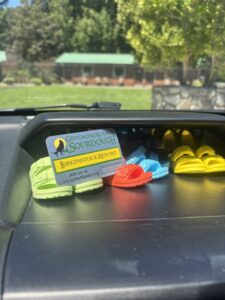
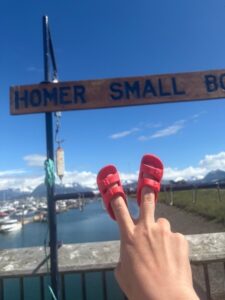
My username is BirkenstockReport. I wear neon colored Birkenstock Arizona UVA sandals pretty much every day of the year. Sometimes even with socks! I earned my name by providing a “Birkenstock-friendly” rating on all the caches I find. When I rate a cache, I am basically telling you if you could find this cache wearing rubber sandals.
The reason behind the Birkenstocks is that I had a bout with Guillain-Barré syndrome when I was 19. I lost feeling in my hands and feet, and grew slowly paralyzed until my amazing team of doctors at OHSU could diagnose me. I received donor antibodies (thank you for your blood donations!) and regrew my nerve function over the next year, but even after I learned to walk again, the hands and feet never really came back. You can learn more about my journey here. As a result, I find that the fewer layers on my hands and feet, the less clumsy I am, hence the toes out in an arctic climate. I do find caches while wearing boots or tennis shoes when I need to, but only to protect my skin, since I often don’t realize when I have a splinter, a blister, or frostbite.
Image by BirkenstockReport.
Geocaching HQ: Many of your cache logs include a “Birkenstock rating.” Can you explain your rating system?
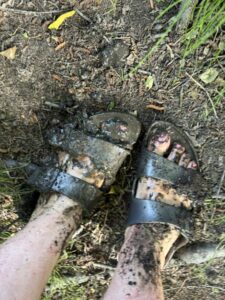
The system can be kind of arbitrary, and also depends on the season. Winter caching in Alaska is not for the weak, so I try to project what it might be like in summer for most of my ratings. A 10/10 means that the cache is probably 100% Americans with Disabilities Act (ADA) accessible, which doesn’t just mean that it’s on paved ground. I pay attention to how far the curb dip is from that portion of the sidewalk, and if there are ADA spaces in the parking lot. I don’t need those supports anymore, but sidewalks without curb dips used to be the endgame for me. A 9/10 is probably a cache hidden on a well-stomped trail. An 8/10 probably isn’t ADA-friendly, but it is probably a grassy area free of thorns and large rocks to trip over. The next big impact is slope. A steep terrain of any kind can make me slide right out of the backs of my shoes, or slide through them and tear them. Those generally run about 5/10. Anything below a 5 means that I would have swapped out to tennis shoes or boots if I had planned better. A low Birkenstock rating does not mean the cache is bad. It just means that I had to plan my route more carefully or come back with friends to be successful.
Image by BirkenstockReport.
Geocaching HQ: What are your must-have supplies or TOTTs (Tools of the Trade)?
My must-have TOTT is bear spray and friends to talk loudly when we are out and about with the big creatures. My other favorite TOTT is my extendable hook. I think it’s usually for grabbing frisbees, but we have a lot of urban high-terrains that require tree climbing or fishing, and I love those ones! Mirror sticks are also great for checking under ledges and such. Caching in Alaska is awesome because you can kinda throw your hands in any little nook and not worry about snakes and spiders, but you can still end up with cuts and bites if you’re not careful.
Geocaching HQ: When you plan an outing, how do you know which geocaches will be accessible?
I love to review logs when I am winding down for the night. If I plan to explore an area, I make a list of caches that I think will be accessible to me. I can handle long walks and steep climbs, but I do struggle with caches that require balance, such as some tree climbs, and especially caches that say “you’ll feel it before you see it.” No, I won’t! I call these splinter caches because I pretty much only come up with splinters that get infected. I really appreciate it when COs include that line on the page or in the hint, because I know to save it for a group outing, or at least to try and pack a mirror stick.
I also find that boulder fields, such as the one that leads to one of Alaska’s oldest caches, can be pretty tricky for me. I’m still going to do it; I just know that I need to take my time and wear layers so that when I do slip, I don’t get scratched and bruised. I’m also probably never going to get a rock climbing cache, and that’s OK! Not all caches need to be for all bodies. That would make the game horrible, because cachers are diverse people and like finding different caches. The important thing is just that the cache page has as much information of that sort as possible to help someone decide what works for them.
Image by BirkenstockReport.
Geocaching HQ: What are some misconceptions about geocaching and accessibility?
Pavement is not automatic accessibility. There are a lot of factors that make a cache accessible or inaccessible. Check out Handicaching.com to explore their rating system to help you understand the factors for people who use mobility devices.
Not all disabilities require the same supports or TOTTs.
There is nothing wrong with hiding only high terrain caches. Hide the kind of caches you want to find.
Not all disabilities require terrain considerations. Warning someone that a cache has flashing lights or a jump scare is helpful, too, if you can find a way to do it without spoiling it. One of my favorite caches of all time would be a nightmare for some of my friends with auditory concerns.
There are caches with higher terrain that are still ADA accessible– especially Virtuals and EarthCaches that can be completed by boat, and Traditionals/Mystery Caches/Multi-Caches that can be found while sitting in a kayak or on a 4-wheeler or while riding a horse. Some of these seem obvious, but if it’s not, consider sharing that on your cache page.
Geocaching HQ: How can cache owners make their caches more accessible?
Be a yapper! Talk about your cache on the cache page. You can do this in a very straightforward way by using a handicaching rating, or explaining the terrain with bullet points, or you can just tell the story of the day you hid the cache. Telling us about where you parked, how far you hiked, what you saw along the way, the snacks you had, what the grass and mud felt like when you slipped, how bad the mosquitoes were, whatever you want. That storytelling shares essential info that can help a cacher decide if this cache is right for them. Plus, reading logs and cache pages is fun. Maybe even more so for people who don’t get to be out in the outdoors as much as they’d like.
Image by BirkenstockReport.
Geocaching HQ: What’s your favorite part about geocaching? What keeps you engaged with the game?
I love being together across time in nature and sharing those experiences with people around me.
I am also a stats nerd and love challenge caches. If you’re feeling stuck in a rut, find some challenge caches and challenge yourself! You don’t even need to sign the log to take on the challenge (just don’t log as found until you’ve actually signed the log, of course).
I am also OBSESSED with the Cache Odyssey series. This is a set of six GeoTours that has hidden a fully ADA-accessible Letterbox Hybrid geocache in each state. They worked really hard to make sure that every cache was unique and interesting. Most of them are Large and require multiple stages or gadgets to find the logbook, and are an awesome way to introduce a friend to geocaching. My first find was obviously the Alaska Cache Odyssey, but every time I travel to a new state, that’s the first cache I look for.
Image by BirkenstockReport.
BirkenstockReport challenges all of us to think more deeply about what “accessible” actually means. Accessibility is more than just an attribute—it includes terrain, environmental conditions, safety information, and detailed cache descriptions.
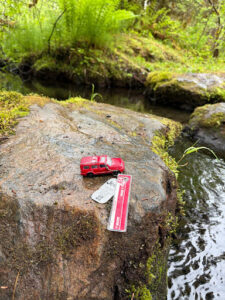
A 2007 Jeep Travel Bug named “Situk River” poses next to its namesake on June 17th, 2026
In 2004, Jeep became the first business to partner with Groundspeak on a trackable campaign. They released 4,000 matchbox-style yellow Jeep Wranglers with custom TB dog tags into the wild. The campaign was so successful that it was followed up in 2005 with 5,000 white Wrangler Rubicons, in 2006 with 6,000 Green Jeep Rescues, and in 2007 with 8,000 red Jeep Commanders. The 2004 jeeps were delineated simply with numbers; the 2005 jeeps were given first names; the 2006 were all named after mountain peaks in the United States, and the 2007 jeeps were labeled with north american rivers. Many of these travel bugs are still in circulation today– a few with the original Matchbox cars, a few with replacement cars or tags, and a few full-on proxies or replacement jeeps.
When they were first published, they all had the same goal, which was simply to move around to caches and meet as many cachers as possible. Of course, some of them were instantly taken and saved for personal collections; some disappeared through normal travel bug attrition, and as they became rarer to find in the wild, some were straight up “stolen” and placed for sale on eBay, with sales topping out over $100 for some. Many folks fought back against this with Jeep TB recovery missions– rescuing them from archived or lonely caches, reaching out to people no longer in the game who had logged them, and helping maintain them in various ways. It’s probably one of those good samaritans who found TB1NN9Y and refurbished it. It still has the original jeep and dog tag, but and they added a laminated card and gave it a mission: to go back to its namesake river, the Situk.
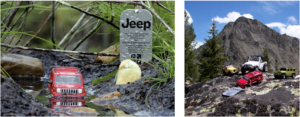
A photo from the geocaching blog talking about promotional trackables.
I was in Iowa in June of 2025 and had only been caching for a little over a month when I saw a “TB Hotel” on the map, GC2G63Z “Rose’s Travel Bug Bed and Breakfast.” Intrigued, I drove over to a neighborhood not far from my hotel and was delighted to find a very large tote next to someone’s front porch. Inside were three very nicely labeled and large pelican cases, the biggest of which was for trackables. I didn’t know much about trackables yet at that point, and hadn’t picked up many, but when I saw that this one wanted to go to Alaska, I snagged it quickly. This was good because in that moment a huge midwestern storm opened up overhead and we went from dry pavement to full hail in the time it took me to close the case up and jog back down the driveway to my car.
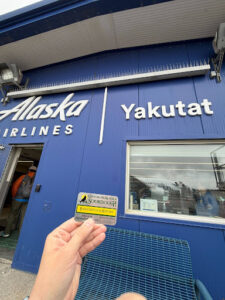
Arriving in Yaukutat just as the rain stopped.
I logged the TB as removed and explored the page a little. What was a Jeep Travel bug? Why was it named after a river in Alaska it had never been to before? I eventually learned what it was and took it with me on the remaining adventures in Iowa and then brought it back to my home in Eagle River. I asked around with other geocachers and even messaged some cache owners for caches in Yakutat, but no one had plans to go anytime soon. So I put it in a little baggy to keep it safe and carried it in my backpack from cache to cache for eleven months. Then, in May, Isaw a heck of a mileage sale through Alaska Airlines and determined that I could get to Yakutat and back in one day for 8,000 miles. I asked my boyfriend Kody if he wanted to join and he said, “of course.” Yakutat is a fisherman’s paradise, well known for its steelhead run among other fish, and Kody is one of those fishing fools. So we booked it, and one year to the day that I had picked it up in Iowa, we were on our way to Yakutat. Kody is about two steps away from being a full muggle, but acquiesced to my request log all the caches he has found while with me after this trip. You’ll see him in logs as Maurice the Manpanion, but call him the Manpanion to his face and I will be in trouble.
We took off from Anchorage at 7 am, and changed planes quickly in Juneau, arriving in Yakutat just after 10 am. Getting upgraded for the 38-minute hop from Juneau wasn’t too wild, as they didn’t have drink service, so we arrived in Yakutat sober and ready for adventure.
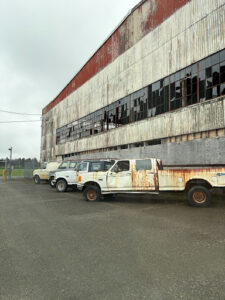
GZ next to Warbird. You can’t tell from this angle, but the first truck is completely v-shaped on top and almost certainly not driveable without xray vision. We pondered what had happened to it quite a bit while driving by .
Our first stop was to pick up the rental car, which we got from Economy Rentals for $70 for the day. The GMC was probably as old as the travel bug with us, and had an actual light switch controlling the driver’s side window, but it was the perfect car for getting around the village. We then swung back to the airport for our first cache of the day, GC3XRFK “Warbird,” hidden by Bearbait Bob in 2012. It was a quick find before we headed down towards the main part of town and picked up coffee from Yakutat Coffee Co and snacks at the AC.
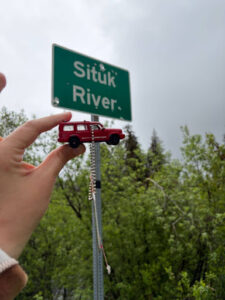
Situk River, AK finally makes it to the Situk!
Then we hit the road to head to Mile 9 Campground, which is nine miles up Dangerous River Road and features a boat launch and several quiet campsites. When we arrived, the whole place was gloriously empty and pristine. With in a few moments, GC5YA2T, Situk Shenanigans, hidden by TundraTim in 2015 was in hand. I dipped the TB in the cache, and then sprinted across the campground to baptize the Jeep in the cool, swift waters of the Situk River!
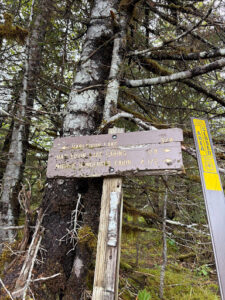
Signs to the public use cabins and a view of the glacial lake.
With the mission accomplished, we decided to spend the rest of the day exploring Dangerous River Road and the rest of the land around Yakutat. We drove another 18 miles out to the end of the road, where it crosses the Dangerous River and dead ends next to an airstrip. The river starts just north of the bridge at Harlequinn Lake, a glacial lake dotted with ice that was slowly migrating down the river. We paused to enjoy the view and learn about the public use cabins nearby, which we are 100% sure we will stay in next year, then hiked around and hid a new cache. GCBRQ13 “Danger is My First Name” is located near the sign welcoming people to the junction in the trail. North to the lake, south to one of the public use cabins! On the way back, we placed a letterbox across the river from Mile 9 Campground and then circled back into town, where “Welcome to Yakutat,” was placed with permission of the land owners, who make a great cup of coffee 🙂 We also DNF’d a cache at Glacier Bear lodge, but I don’t mind having something to redeem on my next trip to Yakutat.
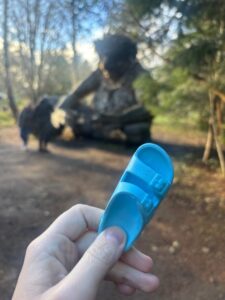
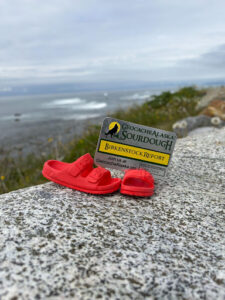
Some mini-birkenstocks enjoying the ocean view on the Peninsula just beyond Yakutat.
We ended the day by driving out onto the peninsula and exploring the cemetery and the beach, before heading back to the airport around 4 pm. We got there about 40 minutes before takeoff (the rental car company said “just leave the keys in the cupholder at the airport, we’ll take care of gas– how far could you have gone?”), but TSA wasn’t ready for us, so we were kindly directed to the bar that shares the diminutive parking lot with the Alaska Air terminal. We had some quick beers while watching our plane change out cargo 30 feet away and then boarded.
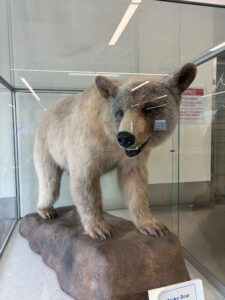
A glacier bear on display in the tiny airport terminal.
We were upgraded again, and this time the flight attendant was ready to keep the party going with an almost excessive drink service on the 37 minutes back to Juneau. We landed in juneau about 1.5 sheets to the wind with a four hour layover, so we hopped in an uber to downtown and had dinner on the warf and then wandered down the road to find a few more caches, including GC3MM5T, “Working in a Gold Mine,” hidden by AlaskanSailors in 2012, which required a little more dexterity to crawl around a very short mine shaft than I expected. Kody has been instructed to delete all photos from that event, but an artist’s approximation is below:
After finding a gold mine, we wandered back through the capitol enjoying some sights as I pointed
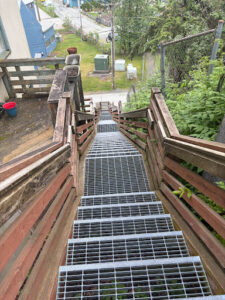
Some of Juneau’s infamous sidewalks, just west of the Governor’s Mansion.
out previous finds to Kody. We saw GC84EMM “Capitol Stones- Juneau Earthcache #44” and checked on GCGAQ1 “Museum Trading Post” and GC10PK7 “House on the Hill” before wandering down the steps to the lower grounds and calling another uber to meet us at the bottom.
We tumbled back to the airport and headed home, arriving in Anchorage around 10:30 pm under the midnight sun. We will be back very soon to enjoy more of Yakutat, which still has three FTFs waiting for the next brave traveler.
As for the jeep, I’m not sure what is next for it. Should I release it into a cache with a new laminated goal and hope no one steals him? Should I display him in my own porch cache, which was 100% inspired by the porch cache I originally found it in? Should I bring it to events for discovery? I think the only sure plan is to not sell it on eBay. Let me know what you think by messaging me on the app!
After eighteen years, I was compelled to remove the container for “Eagles” Turnagain View (GC1BDG1) from the field to comply with the new Alaska State Parks permit size stipulation. The cache was muggled once. It had a beverage can freeze and explode inside, the result of which was so thoughtfully cleaned up by another cacher. Visiting cachers reminisced about getting married nearby. My family and I brought the
GeoSledDogs here many times.
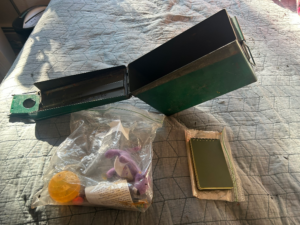
The Eagle Scout Project bench lives on. The bench’s brass plate did not, first being spray painted over, then severely scratched, andfinally stolen. The plate information was added to the hint to keep the multi- cache aspect alive rather than changing the cache page to an offset multi-cache. The ammo can lived in obscurity, its presence having less impact on the area than the wind and foot traffic slowly eroding the bench’s footings. I will always ponder the “why” of the stipulation, but it is what it is. After all that time in the wild, the contents were dry and there were no alcohol, drugs, food, or scented items found within (see photo).
The Turnagain Arm Trail and the view from here did not disappoint this evening. After many days of overcast skies, extreme blue conditions struck southcentral Alaska and I was reminded about the real reason for coming here. Caching truly is about the journey more than the smilie. In this case, thesmilie was on my face as opposed to my profile, which will show one more archived cache page.
Some geocachers have been energetically taking action on geocaches located within Alaska State Parks parcels. To date, nearly 200 geocaches have been archived and nearly 100 geocaches have received the required annual owner maintenance visit and log, out of an original starting list of nearly 1100 geocaches.
Geocachers who are removing caches from Alaska State Parks are requested to do the following:
Read the permit and bullet points about the permit LAS 35694 which are posted at https://gcak.org/advocacy/. It is important for every Cache Owner owning a cache in an Alaska State Parks parcel to understand the permit stipulations and to abide by them.
For their own caches, please archive the cache page. It is advised to write a note to the cache page ahead of time so other geocachers are not looking for a cache after it has been removed from the field, but before the archive log is written.
For Cache Owners who are choosing to downsize caches to micro or smaller rather than archive larger caches in Chugach State Park, update the cache page with the new cache size as soon as possible to avoid confusion in the field with future seekers.
For cachers removing caches with permission of other cachers, write an “owner maintenance requested” log to the cache page notifying their cache has been removed from the field so they may archive the cache page. This step may be done via messenger, text, or other means, as long as the Cache Owner knows when it is time to archive their cache page(s). It is advised for the Cache Owner to write a note to the cache page ahead of time so other geocachers are not looking for a cache after it has been removed from the field, but before the archive log is written.
It is recommended cachers do not remove caches owned by apparently “inactive” cachers. The public-facing date on a cacher’s profile page only reflects the last time they visited the geocaching website using a browser, NOT when they last used the app. Some geocachers exclusively use the app. GeocacheAlaska! is obtaining guidance from Geocaching HQ about how to manage removal of caches owned by apparently “inactive” cachers and active cachers who do not respond to the Reviewer Notes and impending “Temporarily Disable” notes. Also, there are caches in the field belonging to deceased cachers’ estates and there are adoption activities to execute as well as disposition directions to receive for unadopted caches. This last point is specifically applicable for FrostG1anT and scobey caches.
Remember to write an “Owner Maintenance” log to the cache page after visiting a cache and signing the log. The log signature and cache page log will serve as proof of the required annual cache maintenance visit.Regards,Mike/Greatland Reviewer
Groundspeak Community Volunteer





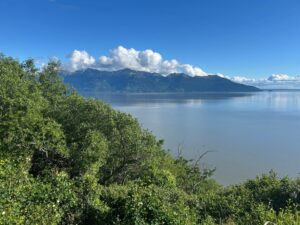 The Turnagain Arm Trail and the view from here did not disappoint this evening. After many days of overcast skies, extreme blue conditions struck southcentral Alaska and I was reminded about the real reason for coming here. Caching truly is about the journey more than the smilie. In this case, thesmilie was on my face as opposed to my profile, which will show one more archived cache page.