NEW!  2026 Alaska State Parks Permit

GeocacheAlaska! Inc.’s 2026 permit for geocaching within Alaska State Parks

GeocacheAlaska! Inc. applied near the end of 2025 for the annual permit to place geocaches within Alaska State Parks for the year 2026.  New permitting processes and requirements and a newly revised assessment of the impact of geocaches on Alaska State Park lands has led to major changes in gaining permission via a permit in order to continue geocaching activities across Alaska State Parks (ASP). Please read all the way to the end to see how GeocacheAlaska! Inc. is proposing to meet ASP requirements so we can continue to geocache across Alaska State Parks.

Geocaches placements are now described as noncompliant use of public lands,
because the geocache container is private property being left on public lands.  The new Permit details are listed here for your review. I’m going to draw attention to significant changes, and how GeocacheAlaska! Inc (GCAK) plans to help meet the new permit terms. While GCAK has negotiated the permit and paid its expense so we can continue to play our game across Alaska’s State Parks, it remains the responsibility of individual cache owners to conform to the terms of the permit. GCAK is asking cache owners to comply by August 31, 2026, to give time to prepare year-end reports.


There are eleven special stipulations, in addition to the new $1,350 three-year permit fee.

1 – Caches are prohibited in all State Historic Parks (such as Totem Bight and Independence Mine); a full list of such ‘historic’ parks is under development now and will be shared soon.

2 – Geocaches are no longer allowed in any designated campgrounds, meaning existing caches in campgrounds must be archived and removed immediately.

3 – Inside Chugach State Park new size restrictions limit caches to preforms or smaller; anything larger must be removed or replaced with compliant sizes. We suggest archiving large caches now.

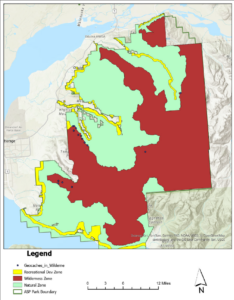
4 – There is a new exclusion zone within Chugach State Park’s new Wilderness Zone (shown on an attached small-scale photo), where caches are prohibited (and any existing caches must be archived and removed immediately).

5 – The fifth stipulation reinforces the exclusion of food or scented items from geocaches.

6 – ASP is prohibiting caches from being placed on, in or tied to bear boxes, latrines, cabins or any other park facility or structure. Current caches placed like this must be archived immediately.
7 – This is going to get perhaps the most attention – it requires an annual cache inspection to be documented on the cache log and online by the cache owner – and violation of this provision is grounds for immediate archival at the end of year reporting date if it hasn’t been done.
8 – GCAK is going to be conducting EduVents to train cache owners and users regarding proper caching behavior.  The first of these EduVents will occur in mid-June.

9 – This is a desperately critical requirement that limits the number of caches allowed across all state parks to not exceed 500 caches total – meaning more than 650 caches must be archived by year’s end. This is one of our most challenging requirements to achieve

10 – This reinforces the ammo-can as a maximum cache size (except in the already-stated Chugach State Park zone where preforms or smaller are required).

11 – The eleventh provision requires an end-of-year report from GCAK to ASP. 

12 – Item twelve reinforces the need to inform all cache owners of the new provisions, with a target of compliance by the end of August so as to give GeocacheAlaska! Inc time to review compliance.

13 – Item 13 was added by the state to encourage geocachers to become members of GeocacheAlaska! Inc. – the permit holder – in an effort to support permit costs and compliance. However, this item is invalidated by Groundspeak Inc. legal policies which don’t allow regional permit holders to require organization membership to be involved in geocaching on permitted lands.
_________________________________________________________

How is GeocacheAlaska! Inc. going to attain compliance with the new permit?

The biggest challenge lies in getting cache placement numbers below the 500-cache limit. This will be accomplished in a number of ways – all of which depend on individual cache owners for action. Here’s a list of suggested actions for individual cache owners to help us get under 500:

1) Caches inside Chugach State Park?  If they’re inside the Wilderness Zone, they must be archived and removed immediately. All other caches larger than a preform should be archived and removed to help reduce cache numbers and build compliance no later than August 31st (note that downsizing and editing the cache page will affect Challenge and Treasure statistics).   Any caches in a designated campground must be archived immediately and removed.

2) Caches placed on ASP facilities and structures must be archived; this in preference to trying to relocate the existing cache placement due the cache quantity limit.

3) Owner maintenance visits must occur and be logged on ASP caches by August 31st.  This is a major issue with caches placed in state parks – inspections by park rangers are revealing a very low compliance rate with previous permit requirements to inspect and log owner maintenance on cache placements in ASP.  Rangers will be holding individual cache owners accountable for this requirement. It’s suggested that if you own a cache that you have a hard time getting out to for the owner maintenance requirement, archive it!


Let’s keep ourselves accountable for the best effort possible to keep our geocache placements in excellent condition. There is no shame in self-archiving geocache placements which have become too difficult to maintain.

If you own geocaches inside State Parks, this summer must find you getting your caches into compliance with our permit or getting your caches archived.

GeocacheAlaska! Inc. volunteers already have dozens and dozens of hours invested in this project and are expecting to spend hundreds more in follow up and reporting. We’ll be reaching out cache by cache as needed to try and gain compliance with permit requirements. Contact Wes Skinner if you have questions ( president@geocachealaska.org ) and be watching for EduVents coming soon.  Note that our state park rangers are genuinely interested in seeing geocaching happen across Alaska State Parks – but it has to happen in compliance with the permit! Individual cache owners could be subject to fines as high as $350 for noncompliance!

Alaska State Parks has issued this permit with its stipulations in order to make it possible for geocaching to continue to be played across Alaska State Park lands. Please help us continue access for geocaching by helping achieve compliance with the ASP permit provisions!


Wes Skinner, President


Via The Geocaching Blog

When geocachers step outside with a GPS-enabled device, they’re tapping into decades of brilliant science and mathematics that make those coordinates possible. Behind every successful find stands a brilliant mathematician whose work helped make modern GPS possible: Dr. Gladys West.

1930 – 2026
Image from the New York Times.

Gladys West’s groundbreaking work focused on solving a deceptively complex problem: determining the Earth’s precise shape.

In the 1960s and 1970s, West helped process vast amounts of satellite data to model Earth’s geoid. Because satellites orbit based on Earth’s gravitational field, understanding this shape was essential for calculating accurate positions on the planet’s surface. West programmed early supercomputers to analyze oceanographic and satellite measurements, producing increasingly precise models that became foundational to the development of the Global Positioning System (GPS). When GPS satellites were later deployed, they relied on these accurate Earth models to translate satellite signals into the exact coordinates we use today for navigation, mapping, and location-based technologies.

Geocaching is built on a beautifully simple idea: use GPS coordinates to find hidden treasures around the world, but the magic behind those coordinates depends on an incredibly sophisticated system of satellites, timing signals, and Earth models.

Thank you, Gladys West, for advancing geodesy and satellite modeling, making the precision of geocaching possible!


Celebrate Blue Switch Day 2026 by hiding a geocache, and earn your Blue Switch Day 2026 hider souvenir.

Blue Switch Day 2026 hider:

  • To earn this souvenir, geocachers must have a non-Event geocache published between May 1 and 31, 2026.
    • Any non-Event geocache type (excluding Adventure Lab®) counts, as long as it is published between May 1 and May 31.
    • Remember that review times may vary! A geocaching community volunteer will typically begin reviewing your geocache within 7 days. We recommend submitting your cache for publication at least a week before the deadline. Learn more about the cache review process in our Help Center.

How will you celebrate Blue Switch Day this year?


Via The Geocaching Blog

Upcoming Events:

April 29GCBN9N7  I’m losing it…. (Eagle River)

April 30GCBM70N Maker Magic 2026: Tree-Friendly Birdhouse Hides (Eagle River)

May 1GCBNBZ0 Stammtisch May Day (XLVII) (Anchorage)

May 2GCBN1KK  SYCS: April Showers Don’t Bring May Donuts? (Palmer)

May 2GCBN9ME scobey the Puzzlemeister (Anchorage)

May 4GCBKCV9 SYCS: Lekker April (Palmer)

May 4GCBKJR1 Blue Switch Day (Anchorage)

May 4GCBKJR1 Blue Switch Day (Anchorage)

May 6GCBMZMD The LAST SCYS: Sleepy Thursday  (Eagle River)

May 10GCBMYN6 👋 Meet & Greet ☕️ (Juneau)

May 11GCBNH6K  Geocaching for old caches in Sitka (Sitka)

May 16 GCBNDJY – Im stealing this from Brik (Chugiak)

May 16GCBNJYP RB & Cyto’s Palmer Cleanup! CITO (Palmer) 

May 16GCBKBRD Springtime in Seward – The Mermaids are about (Seward)


Upcoming Souvenirs:

Cache In Trash Out®, Season 1 – March 1–May 31

Log any CITO event to qualify

Maker Magic – April 9-30

Attend any Maker Magic event to qualify

Blue Switch Day Finder– May 1-31

Find any Geocache or attend an event to qualify

Blue Switch Day Hider – May 1-31

Have a non-Event Geocache published  to qualify

2026 Hider

Hide any Geocache in 2026 to qualify

Celebrating 25 Years – no time limit

Find all 5 treasures in “Celebrating 25 Years” Treasures collection to qualify

“Treasures” Milestone Souvenirs:

  •  Collect 100 Treasures
  • Collect 200 Treasures
  • Collect 300 Treasures
  • Complete 10 collections
  • Complete 25 collections
  • Complete 50 collections

For a full list of upcoming souvenirs, visit: 2026 Confirmed Souvenirs on the Geocaching Blog

General Notice about the Alaska State Parks permit status:  


Our previous permit is expired and no longer useable for cache placements. GeocacheAlaska! Inc. has been negotiating a new permit with Alaska State Parks over the last few months. The State is adding a number of new restrictions for placing geocaches on State Parks lands. Until the new permit is finalized and the geocaching community brings all existing caches into compliance with the new permit, there will be no new cache placements accepted by Geocaching HQ and our regional Reviewer for any Alaska State Park location. We anticipate having the final permit back by mid-May and it will be published shortly afterward. We are also building an educational campaign describing each permit requirement and that will be rolled out when we publish the new permit in it’s final language.


By Mike Malvick (GreatlandReviewer/ladybugkids)

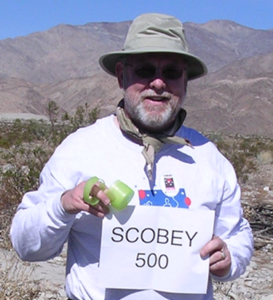
scobey, archived

John Leon Scoblic (aka scobey), age 76, of Anchorage, Alaska, passed away on Dec. 25, 2025, at home after a long and valiant battlewith   cancer.  His full obituary was published in the Anchorage Daily News on January 4, 2026.  His funeral was held at St. Elizabeth Ann Seton Catholic Church on January 10, 2026, and he was interred at Fort Richardson National Cemetery in April, 2026.

Scobey was a fixture of geocaching in southcentral Alaska for six years beginning in 2004, before his health and other factors limited his ability to get outside and enjoy one of his favorite pastimes.  Despite being active for a relatively short stint, his geocaching legacy lives on through his caches and GeocacheAlaska!

Scobey’s family engaged in geocaching and his wife Linda, and his daughter, Alicia (aka Geminigirl) often accompanied him on his caching outings.  His adult son, John, also tagged along when scobey visited his family in Ketchikan, Alaska, and scobey commemorated the birth of his second grandson, Jonathan, with Johnathan’s Cache.  His beloved bichon frise dog, “Beamer,” was rarely far from scobey.

Scobey has numerous notable caching firsts in Alaska:

  • First Challenge Cache: Alaska Borough and Census Challenge (GCYPMN)
  • First GeocacheAlaska! website
  • Launched the GeocacheAlaska! Forums
  • Founding Member of GeocacheAlaska!
  • First Alaskan cacher pathtag (scobey)
  • First Alaskan dog pathtag (Beamer)
  • First Alaskan to break a bone while caching, which led to the production of the “Geocacher Needs Maintenance” geocoin and pin as a show of community support for his quick recovery. Be sure to click the link for the full story in the geocaching.com forums. 
  • First or second nano cache placed (I was unable to confirm whether the community gets to blame scobey or oleruns for this)

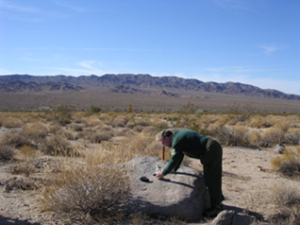
In addition to geocaching, scobey also enjoyed hunting for benchmarks, and frequently placed caches near them to highlight their presence and encourage other cachers to log them both at geocaching.com and the United States Geological Society (USGS) sites.  He was regularly found scouring an area with a metal detector and a shovel, searching for “marks” that urban sprawl had covered.  
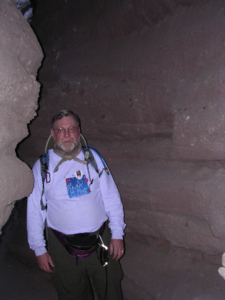
Scobey enjoyed combining traveling with caching and attended the third annual Geocoinfest (2007) in Temecula, California, and cached his way through palm tree oases, slot canyons, and nearly got arrested by tribal police at the edge of a casino parking lot while hunting for a cache that was placed without tribal permission.  His southernmost find is in Ecuador and his easternmost find is in the Philippines.  He also cached in Dubai, United Arab Emirates. 

Scobey was always loyal to technology and enjoyed razzing anyone who used a Magellan rather than a Garmin GPSr.  He also applied technology to his caches, including the still active Radio Days (GC1JWBZ) multicache.  Scobey enjoyed creating series of caches to reveal his love of:
 

Scobey was a complex, talented, and generous person who brought his varied interests to the local caching community and we are better for it.  He is missed.

Note:  A geo-memorial celebration of caching, “Scobey the Puzzlemeister(GCBN9ME) is scheduled for 4:00-5:30 p.m. on Saturday, May 2, at Russian Jack Park North Pavilion.


By Mike Malvick (Greatland Reviewer/ladybugkids)

The following is adapted from a Geocaching.com Forum post written by Community Volunteer Reviewer Keystone nearly twenty years ago in June 2006, with minor modifications based upon Guideline changes and conditions specific to Alaska.  Keystone has reviewed cache pages for Pennsylvania and Ohio since 2003.

When reviewing a new cache page submission, the Community Volunteer Reviewer (Reviewer) starts with the proposition that the hider of the cache is responsible for obtaining “adequate permission.” Note that it says “adequate permission” in the Guidelines — NOT just “permission.” The Reviewer relies upon cache owners to think about this issue and make a determination about what permission is necessary. In submitting a cache page, the geocacher assures the listing service (Groundspeak/Geocaching HQ/Geocaching.com) that adequate permission has been obtained, and the listing service assumes that this is the case. As a listing service, Geocaching.com is not a guarantor of the proposition that every cache is placed with permission. But sometimes there are circumstances why this assumption ought to be questioned. Here are some of them:

  1. When a landowner/land manager such as a park system (Alaska State Parks is GeocacheAlaska!’s primary permit issuer) or a private land conservancy trust has a published geocaching policy that Groundspeak is aware of, then the Reviewer will ask the cache owner about compliance with that policy. Knowing of the policy’s existence, it is not appropriate to blindly assume compliance with the policy if no mention is made of this on the cache page. So the Reviewer will ask whether a required permit has been obtained or, in the case of a blanket permit such as with Alaska State Parks, if the stipulations of the permit are met.  In some cases, such as National Parks, National Wildlife Refuges, and National Monuments, which generally do not have an open geocaching policy, we will ask whether the hider obtained explicit permission from the Land Manager or their designee. 
  2. When a cache is hidden on land that is obviously private, like someone’s back yard, it is unwise to blindly assume permission. Usually permission is stated or implied on the cache page (“this cache is hidden in our front yard — please, no night caching”). If it isn’t, the reviewer may ask about it. The guidelines require permission for caches hidden on private property. There’s even a specific sentence about never ignoring a “no trespassing” sign.
  3. Some locations are so sensitive in nature that it is unwise to assume that permission has been obtained, so specific listing guidelines have been adopted to guard against placements in those areas. Examples include airports, government buildings, school yards, dams, highway bridges, and utility infrastructure. If the reviewer sees a cache in one of these locations, they will challenge the assumption of adequate permission by reference to these specific guidelines.

In most other cases — ranging from suburban parks to shopping centers to little free libraries — it is up to the cache owner to determine what constitutes “adequate permission.” One cache owner might conclude that no formal permission at all is needed for a particular spot, while another will obtain written or oral permission for a different cache location because their instinct tells them that permission is a good idea. If the cache owner arrives at an unwarranted conclusion, the listing service will react to questions about permission. First, if a land owner/land manager requests removal of a cache placed without permission, Groundspeak’s policy is to archive the cache unless and until the hider is able to straighten things out and provide an explanation of clear permission. Second, if another geocacher sees a cache location which causes them to have doubts about permission, they are welcome to raise their concern with the cache owner. If that is not productive, the geocacher may contact  Groundspeak via the Contact Us link, contact the local Reviewer, or write a “Reviewer attention requested” log on the cache page. The system is thus largely self-policing in this majority of circumstances.

By Louise Kempker (freeweez)

It’s Spring—and for Geocachers–that means you are now able to search & find those smileys that may have been hidden all winter long!

The German Exchange Cache – GCAGN3J  –  is waiting just for YOU!  There are German cachers awaiting a ‘partner’ here in the Anchorage area—so please head on over and find this Multi with a partner.  You find the first stage in Anchorage (easy PNG) –and send the coordinates inside the container to your German ‘partner”—and they will send Final coordinates back  to you.  The final is a short walk in Kincaid Park–and should be pretty uncovered with snow by now! Cache On—and venture forth into New Country-to Country caching!  

Via: The Geocaching Blog

When you see a blue question mark on the map, do you feel curious—or confused? Mystery Caches—also known as Puzzle Caches—can be intimidating. Some puzzles involve codes or ciphers. Others require solving math problems, answering questions, or reviewing the cache page for hidden clues.

Solving puzzle caches takes patience, attention to detail, and a willingness to try different approaches. We asked geocachers to share their best advice for getting started.

Note: Some of the responses have been edited for clarity and brevity.

  • “You are trying to find final coordinates. Knowing what you need in the end can help to get you thinking in the right direction and give clues to potential pieces of information.” – emilierene
  • “First, put yourself in the creator’s shoes. Consider the meaning of the title and why it was placed here. Don’t overlook even the smallest hints.” – GC Gakujgn
  • “Read, read, read… and did I say ‘read again’? Even I get caught up in the moment and adrenaline rush and still sometimes miss essential details, especially when you have to do translations.” – FindingNiels
  • “We hold occasional puzzle-solving events. Everyone brings a list of puzzles they want help with. We take turns working on the puzzles together.” – Marguerite B.
  • “Gradually accumulate skills and learn from others. Use the D-rating as a guide—D1 and D2 are usually suitable for beginners. Tackling a D4–D5 right away will probably discourage you and make you give up.” – Thomas T.
  • “With puzzles that require full coordinates, look for patterns that produce the first part you already know. For example, if I’m solving locally and expect South 30°, I’ll look for ways the puzzle could result in S30 or ‘South Three Zero.’ Solving a puzzle that has stumped me for months is honestly one of the most satisfying things I have ever experienced. Sometimes it just takes the right mood, location, or moment for your brain to find the key to start unravelling it, even if you’ve stared at it for many hours previously.” – Nicole S.
  • “I like to print out puzzles so I can make notes. When I’m stuck, I reach out to previous finders or the CO. I also bring puzzles to events to see if others have insight, and keep some in a folder to work on when the weather isn’t caching-friendly.” – Laura L.
  • “Attend events and ask questions. Or check if there’s a puzzle group in your area (don’t forget online groups. We have two very active online puzzle-solving groups based in Victoria, Australia). If there are no groups, consider a puzzle-solving event. All the geocachers I know generally want to help out or learn!” – LetThemEatCache
  • “There are so many aspects to geocaching; find the ones that bring you joy, and leave the rest for others to enjoy. If puzzles are more frustrating than joyful, put them aside. That being said, the more you work on them, the better you will get, which can bring you joy.” – gsmX2

Here are some online resources that may give you more tricks to try:

Looking for more guidance? How to Puzzle Cache (Second Edition) by Cully Long—featuring over 300 pages of lessons, tips, and step-by-step techniques for tackling everything from codes and ciphers to math, music, and more—is available at Shop Geocaching


Via The Geocaching Blog

Whether you’re out on a hike or visiting a local park, sometimes you come across a spot and think, “That would be a great place for a cache.”

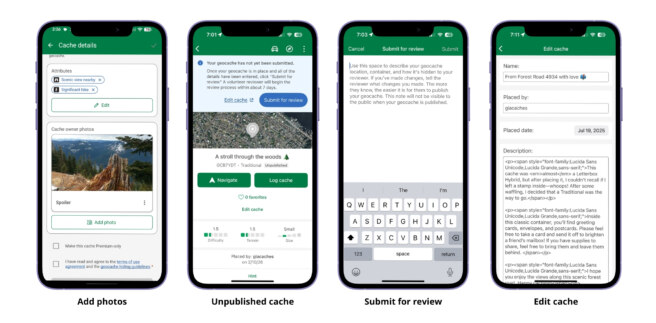
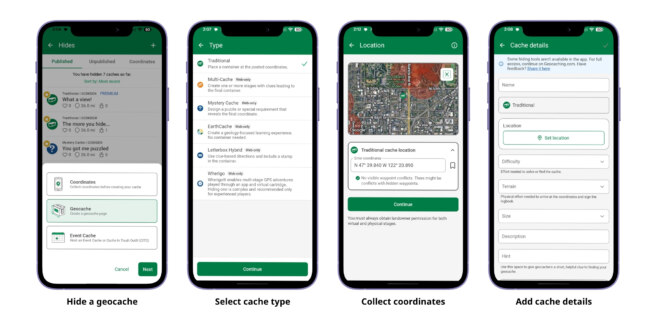
With the latest Geocaching® app release (version 10.7.0+), you can now record a hiding spot, add cache details, and submit a Traditional Cache for review—all from the mobile app!

Earlier this year we introduced the coordinate collector to help players capture accurate coordinates in the field. Now we’re taking the next step toward a more mobile-friendly hiding experience by bringing key parts of the Traditional Cache hiding process into the Geocaching® app.

Get started from the Hides tab

To begin, open the Hides tab in the app and tap the + in the upper right corner. Select ‘Geocache,’ then Traditional Cache.

Currently, Traditional is the only cache type that can be created, edited, and submitted from the app. Selecting another cache type will open a mobile web browser so you can continue creating the listing on Geocaching.com.

From the app, you can now:

  • Name your geocache
  • On the Location screen, enter coordinates or tap the bookmark icon to collect coordinates or choose saved coordinates
  • Set difficulty and terrain ratings, and size
  • Add cache details like the description and hint
  • Add attributes to help future finders know what to expect
  • Add and describe a helpful image (e.g. location or spoiler)
  • Make sure your cache container is placed and ready to be found
  • Submit your cache for review by a community volunteer reviewer


If you still need to place the container or want more time to add details, you can save the listing and finish it later. Edit your Traditional Cache in the app (Hides tab > Unpublished) or from your cache owner dashboard on Geocaching.com.

Ready to hide? Visit Shop Geocaching to browse cache containers in a variety of sizes, colors, and shapes.

NOTE: Creating a cache listing does not reserve or guarantee a location for your cache. To learn more about hiding guidelines, visit the Help Center.

By Mike Malvick (Greatland Reviewer / Ladybugkids)

Groundspeak (Geocaching HQ) have recently communicated to Reviewers that “having a healthy and well maintained gameboard is vital to the game and important to us, it is the number one feedback we get from players via surveys.”  To expand on the sentiment, the following guidance was provided to Community Volunteer Reviewers:
  • Ideally, caches should not be disabled long term. The Hiding Guidelines state “A cache page can stay disabled for a reasonable amount of time – generally up to four weeks.”  
  • If the cache owner is active and responsive, it is the Reviewer’s discretion to decide what the maximum length of time the cache remains disabled. For inactive or unresponsive cache owners, the 4 week guidance should be applied.  Reviewer discretion may also be applied for caches in remote locations (mountains, coastal islands, etc.) where seasonal conditions are a factor.

There are currently 427 (5.6%) caches in Alaska with the “Owner Attention Requested” (formerly “Needs Maintenance”) red wrench attribute.  Cache Owners can check their dashboard at Geocaching.com – Cache owner dashboard for caches with this attribute and should visit the cache and perform any required cache maintenance so their cache is ready when peak caching season begins.

There are currently 124 (1.6%) caches in Alaska that are “Temporarily Disabled,” with most exceeding the four week standard.  Most, if not all of these caches have received one or more Reviewer Notes requesting a status or action on the cache.  Geocaching HQ gives latitude to Reviewers to work with responsive cache owners and all it takes to be considered “responsive” is to respond to the “Reviewer Note” is a “Write Note” log on the cache page in response to the “Reviewer Note.”

Combined, there are currently 348 caches in Alaska that need some kind of attention, with most needing it since at least Autumn 2025.  Some caches have an “Owner Attention Requested” attribute, a “Reviewer Attention Requested” log, or are temporarily disabled, or up to all three!

The past month has featured lots of snow and unseasonable cold spells, but it is not too soon to write your cache notes and plan maintenance trips for when the warmer March and April days come.

Geocaching HQ’s standard for an awesome gameboard is 98% healthy caches.  Let’s see what Alaskan cachers can do to get there before the cruise ships start calling at Alaskan ports in earnest.”