
NEW! 2026 Alaska State Parks Permit
GeocacheAlaska! Inc.’s 2026 permit for geocaching within Alaska State Parks
GeocacheAlaska! Inc. applied near the end of 2025 for the annual permit to place geocaches within Alaska State Parks for the year 2026. New permitting processes and requirements and a newly revised assessment of the impact of geocaches on Alaska State Park lands has led to major changes in gaining permission via a permit in order to continue geocaching activities across Alaska State Parks (ASP). Please read all the way to the end to see how GeocacheAlaska! Inc. is proposing to meet ASP requirements so we can continue to geocache across Alaska State Parks.
Geocaches placements are now described as noncompliant use of public lands,
because the geocache container is private property being left on public lands. The new Permit details are listed here for your review. I’m going to draw attention to significant changes, and how GeocacheAlaska! Inc (GCAK) plans to help meet the new permit terms. While GCAK has negotiated the permit and paid its expense so we can continue to play our game across Alaska’s State Parks, it remains the responsibility of individual cache owners to conform to the terms of the permit. GCAK is asking cache owners to comply by August 31, 2026, to give time to prepare year-end reports.
There are eleven special stipulations, in addition to the new $1,350 three-year permit fee.
1 – Caches are prohibited in all State Historic Parks (such as Totem Bight and Independence Mine); a full list of such ‘historic’ parks is under development now and will be shared soon.
2 – Geocaches are no longer allowed in any designated campgrounds, meaning existing caches in campgrounds must be archived and removed immediately.
3 – Inside Chugach State Park new size restrictions limit caches to preforms or smaller; anything larger must be removed or replaced with compliant sizes. We suggest archiving large caches now.
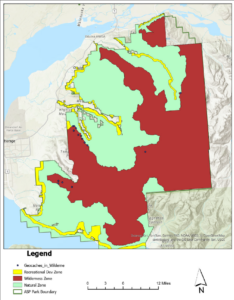
4 – There is a new exclusion zone within Chugach State Park’s new Wilderness Zone (shown on an attached small-scale photo), where caches are prohibited (and any existing caches must be archived and removed immediately).
5 – The fifth stipulation reinforces the exclusion of food or scented items from geocaches.
6 – ASP is prohibiting caches from being placed on, in or tied to bear boxes, latrines, cabins or any other park facility or structure. Current caches placed like this must be archived immediately.
7 – This is going to get perhaps the most attention – it requires an annual cache inspection to be documented on the cache log and online by the cache owner – and violation of this provision is grounds for immediate archival at the end of year reporting date if it hasn’t been done.
8 – GCAK is going to be conducting EduVents to train cache owners and users regarding proper caching behavior. The first of these EduVents will occur in mid-June.
9 – This is a desperately critical requirement that limits the number of caches allowed across all state parks to not exceed 500 caches total – meaning more than 650 caches must be archived by year’s end. This is one of our most challenging requirements to achieve.
10 – This reinforces the ammo-can as a maximum cache size (except in the already-stated Chugach State Park zone where preforms or smaller are required).
11 – The eleventh provision requires an end-of-year report from GCAK to ASP.
12 – Item twelve reinforces the need to inform all cache owners of the new provisions, with a target of compliance by the end of August so as to give GeocacheAlaska! Inc time to review compliance.
13 – Item 13 was added by the state to encourage geocachers to become members of GeocacheAlaska! Inc. – the permit holder – in an effort to support permit costs and compliance. However, this item is invalidated by Groundspeak Inc. legal policies which don’t allow regional permit holders to require organization membership to be involved in geocaching on permitted lands.
_________________________________________________________
How is GeocacheAlaska! Inc. going to attain compliance with the new permit?
The biggest challenge lies in getting cache placement numbers below the 500-cache limit. This will be accomplished in a number of ways – all of which depend on individual cache owners for action. Here’s a list of suggested actions for individual cache owners to help us get under 500:
1) Caches inside Chugach State Park? If they’re inside the Wilderness Zone, they must be archived and removed immediately. All other caches larger than a preform should be archived and removed to help reduce cache numbers and build compliance no later than August 31st (note that downsizing and editing the cache page will affect Challenge and Treasure statistics). Any caches in a designated campground must be archived immediately and removed.
2) Caches placed on ASP facilities and structures must be archived; this in preference to trying to relocate the existing cache placement due the cache quantity limit.
3) Owner maintenance visits must occur and be logged on ASP caches by August 31st. This is a major issue with caches placed in state parks – inspections by park rangers are revealing a very low compliance rate with previous permit requirements to inspect and log owner maintenance on cache placements in ASP. Rangers will be holding individual cache owners accountable for this requirement. It’s suggested that if you own a cache that you have a hard time getting out to for the owner maintenance requirement, archive it!
Let’s keep ourselves accountable for the best effort possible to keep our geocache placements in excellent condition. There is no shame in self-archiving geocache placements which have become too difficult to maintain.
If you own geocaches inside State Parks, this summer must find you getting your caches into compliance with our permit or getting your caches archived.
GeocacheAlaska! Inc. volunteers already have dozens and dozens of hours invested in this project and are expecting to spend hundreds more in follow up and reporting. We’ll be reaching out cache by cache as needed to try and gain compliance with permit requirements. Contact Wes Skinner if you have questions ( president@geocachealaska.org ) and be watching for EduVents coming soon. Note that our state park rangers are genuinely interested in seeing geocaching happen across Alaska State Parks – but it has to happen in compliance with the permit! Individual cache owners could be subject to fines as high as $350 for noncompliance!
Alaska State Parks has issued this permit with its stipulations in order to make it possible for geocaching to continue to be played across Alaska State Park lands. Please help us continue access for geocaching by helping achieve compliance with the ASP permit provisions!
Wes Skinner, President
